Having a baby reshapes life. Health, relationships, identity, routines, work and sleep can all change at once. Mental health is part of that picture too.
As shared by PANDA, research in Australia shows that up to 1 in 5 women and 1 in 10 men experience anxiety or depression during the perinatal period. PANDA also highlight that Families from minority communities face increased challenges including discrimination and barriers to accessing safe support. For some, it’s the first time they’ve experienced significant changes to their mental health. Yet people don’t always recognise what’s happening, know how to describe it, or where to look for help.
Queensland Health wanted to make it easier for parents, carers and families to understand what they were experiencing and where to find appropriate support.
Learning from lived experience
We spoke with parents, grandparents, health professionals, peer workers and NGO representatives across Queensland through trauma-informed conversations.
People trusted us with deeply personal experiences of fear, loss, uncertainty and resilience. We heard how mental health challenges didn’t always look the way people expected, how difficult it could be to put an experience into words, and how quickly information, services and systems could become overwhelming when someone is already distressed.
These conversations helped us understand how people’s needs could change, from early uncertainty through to immediate crisis, and the circumstances that could shape their ability to find and access support.
They also showed us what could get in the way. Stigma, cultural safety, geography, caring responsibilities and uncertainty about whether the right support would be available could all influence whether someone took the next step.
Organising information and supporting people to access support meant we needed to consider what someone might be experiencing when they encounter Queensland Health content, what might stop them from seeking help, and what they needed to understand before they could move forward.
“It’s about how you get that content out to people and how you stop the system from looking fragmented, complex and difficult to navigate.”
— NGO representative
Making the path clearer
We were guided by a key principle: that people shouldn’t need to know the health system’s language to find the right information.
‘Perinatal and infant mental health’ is understood within the health system, but it isn’t necessarily a term parents and carers would use themselves. Some terms aren’t even recognised in dictionaries (see the red squiggle appear when you type ‘matrescence’).
So we organised public content around the experiences and questions people were more likely to recognise in their own lives. Their emotions and wellbeing. Their relationship with their baby. Changes they were noticing. How to support someone close to them. When they might need more help.
Rather than expecting people to seek out specific mental health information, we connected this content with Queensland Health’s existing pregnancy and early parenting information, where we knew parents were searching for ways to support their baby. This meant support could appear where people were already looking, including before they recognised what they were experiencing as a mental health concern.
For health professionals and peer workers, we created a complementary information structure that reflected the public experience, creating clearer connections between information for families and the people supporting them.
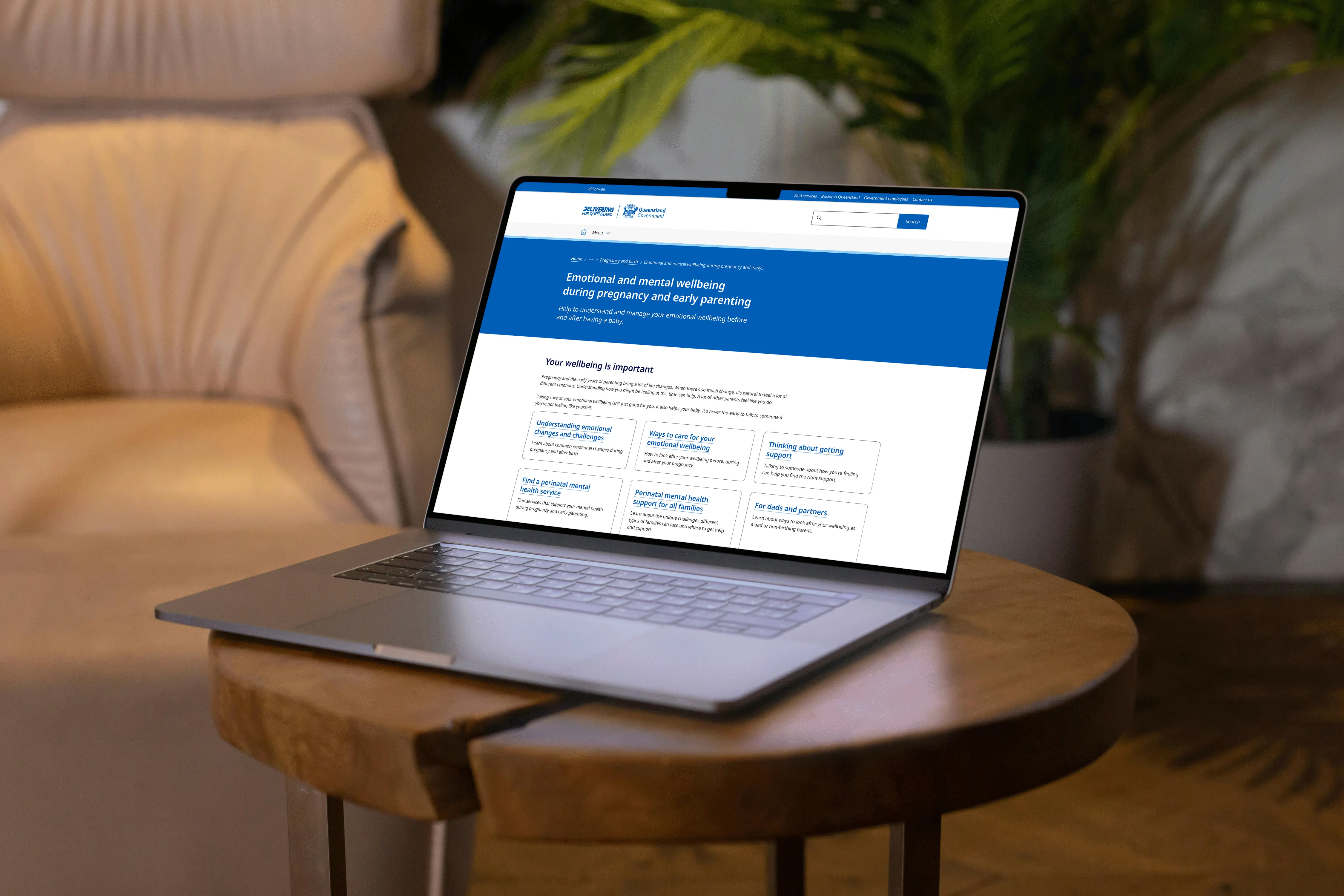
The content has started appearing on the Queensland Government website, bringing lived experience, clinical knowledge and good design together to help parents, carers and families understand what’s happening, find information that feels relevant to them and connect with support that aligns with their needs.