Earlier this week I spent a day at the Policy Innovation for Public Good event, part of the 2026 OpenFisca conference.
It brought together policy people, technologists and designers around a shared problem: policy hasn’t kept pace with the world it’s trying to shape.
Not a new idea for many in the room but the day felt different. Discussion moved beyond diagnosing the problem, and focussed more on what to do next. It asked ‘how might policy as a discipline evolve to meet today’s increasing challenges?’
Policy is under pressure
Michael Outram’s keynote set the tone early. As former Commissioner of the Australian Border Force, Outram drew a clear line between that reality and the growing complexity policy makers are being asked to respond to. From geopolitical fragmentation, to technological disruption, supply chain pressure, and expanding mandates across jurisdictions, a changing landscape requires new approaches to policy and delivery.
Policy is structured in cycles and the systems it operates in are not.
He named three structural gaps that make adaptive policy harder than it should be:
- Knowledge, both how it is generated and shared.
- Visibility, or a lack of visibility within systems.
- Feedback, and a lack of mechanisms to test policy intent.
His framing carried through the rest of the day.
From writing policy to designing systems
The speaker mix was unusually strong. Public servants, behavioural researchers, social designers, technologists, historians, evaluators, open government practitioners and rules as code leaders were all speaking to the same challenge from different angles.
Across many talks, we heard about new methods and approaches that take inspiration from other domains - including that of iterative product design. With the right infrastructure, policy teams can become more integrated with delivery and work in a design, test and learn process.
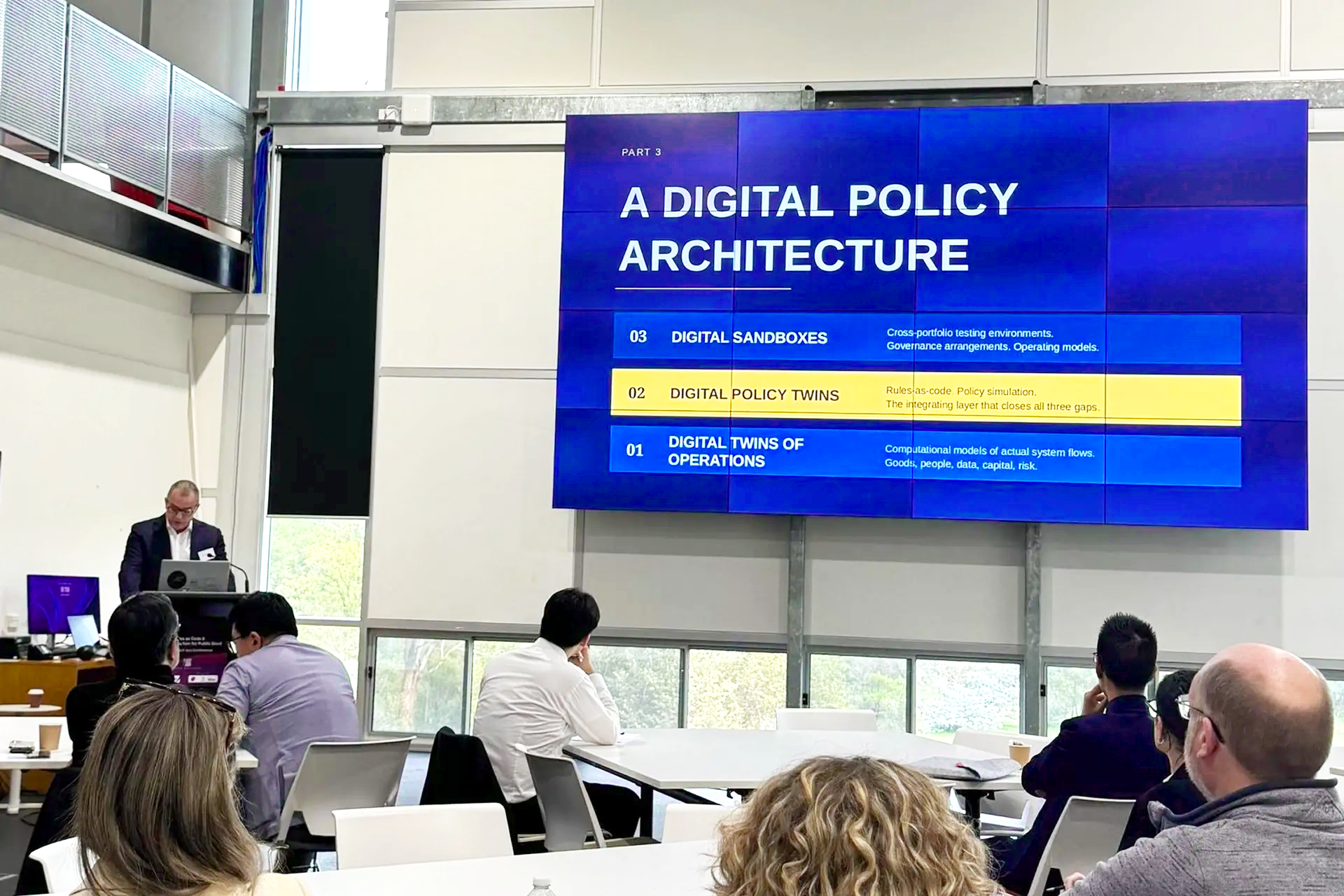
Much like a digital twin, a “policy twin” is a concept that introduces a working model of a policy that lets you see how a policy behaves in its setting before and after by modelling real world changes. This type of infrastructure is underpinned by “Rules as Code” where policy is written in a structured and testable way for machines which enables methods such as scenario planning.
This changes policy work. Policy becomes more explicit and trade-offs become visible earlier. Implementation becomes part of design and participation at scale becomes more possible. Service experiences become more personalised and this all builds more transparency in government.
This is what end-to-end policy starts to look like in practice.
Moving beyond pilots
There is no shortage of good ideas in policy, the real challenge is in getting them to stick.
Pilot projects are useful but in policy settings, they can become a way of avoiding the harder work of embedding change across systems, teams and institutions.
That idea came up in different ways throughout the day. Some governments from around the world are already making the shift. Mechanisms like the Open Government Partnership are helping create the conditions for broader systems change, while practical tools, frameworks and operating models are becoming more available.
Resources like The Policy Playbook are helping build a stronger foundation. Locally, platforms like GovCMS are also starting to support "Rules as Code” in more practical ways.
We are at that awkward but important point where isolated experiments are no longer enough. The next step is embedding the ingredients and infrastructure needed for more adaptive policy design, and better outcomes.
Participation isn’t optional
Participation came up throughout the day, not solely as consultation but as something more structural and built into the process.
That will feel familiar to strategic designers. But in policy, the opportunity is slightly different. It is about creating embedded feedback loops, and building trust into how decisions are made.
Chris Vanstone from TACSI shared some grounded reflections on what participatory policy could make possible noting its criticality in making well informed policy decisions.
The capability gap
If policy is changing, capability needs to change with it. Our neighbours in New Zealand shared the Policy Project and the Policy Skills Framework, which is helping shape capability across government. It was clear that their approach isn’t about layering extra capability, it’s about reshaping how policy teams operate within and that requires more openness to working across disciplines.
Shane Johnson is co-leading the development of Australian Evaluation Profession, he shared some of the thinking behind that work and its connection to support more adaptive approaches. This felt like a significant shift for Australia. More evaluation built into the policy process, not added at the end.
Still human
AI came up throughout the day, but with a consistent view. It can help process information, test ideas and sharpen thinking but it shouldn’t replace human judgement. Policy is still human work.
What we’re taking from it
A few things stayed with me.
- Policy needs to move at the speed of the system it operates in, without losing care or legitimacy.
- Designing and delivering policy can’t be treated as separate activities anymore.
- Participation is not a nice-to-have, it’s part of how better policy gets made.
- And the hard part isn’t the ideas, it’s making this the default way of working.
There’s still a gap between where policy is and where it needs to be but the direction feels clearer. The challenge now is making that shift real.