
Recently, Folk’s community of content practitioners — Sarah Stanford (that’s me!), Miranda Crabtree, and Mel Stenner — attended Working with Gen AI, a 2-day course developed by Content Design London and delivered by Weave.
Although we all learnt a lot, this is not a replay of the 2 days. This isn’t a place to learn how Gen AI works or to teach you how to write winning prompts (we’ll reserve that for our clients).
Instead, we wanted to share some of the big questions, conversations and ideas that have been swirling around our brains, Slack channels and Content Community of Practice meetings since.
Sentiment is curious, but cautious
As we headed into the course, joining a group of people who had signed up to spend 2 days working with generative AI, I expected to be met with unfiltered enthusiasm for adopting AI tools into content practice. Instead, I’d call the sentiment curious but cautious.
Amongst the group, rates of organisational adoption and personal use were mixed. This broadly reflects similar uptake patterns and attitudes toward AI in the client environments we work in. This spread of adoption seems to be driven by a mix of:
- personal attitudes toward the ethics and impacts of AI
- organisational attitudes and guardrails
- what wins out in the battle between caution and curiosity.
Separating the workflow from the work
This curiosity leads to big questions.
As a content strategy team we’ve reflected that the content world is simultaneously trying to stay ahead of:
- how AI changes our workflows (how what we do is enhanced or encumbered by new tools or new features added to existing tools)
- how AI changes the work itself (how does our content strategy and design practice adapt to ensure information is being accurately read and reinterpreted by AI).
At the same time, there’s caution about the ethical and environmental impacts, and an underlying anxiety about the future of our work (and our day-to-day lives).
Whether driven by an external ‘hype’, or organisational pressures, teams are being encouraged to adopt AI tools while simultaneously grappling with these big questions. It’s a lot to untangle all at once.
Teams need time and space to unpack and address each of these issues, separately and together. For content teams, the place they come together is within a content strategy, which should answer:
- how information will be structured, organised and written (to be read and understood by AI and humans)
- how AI might fit into writing and review processes
- how both the content and the workflows will be governed.
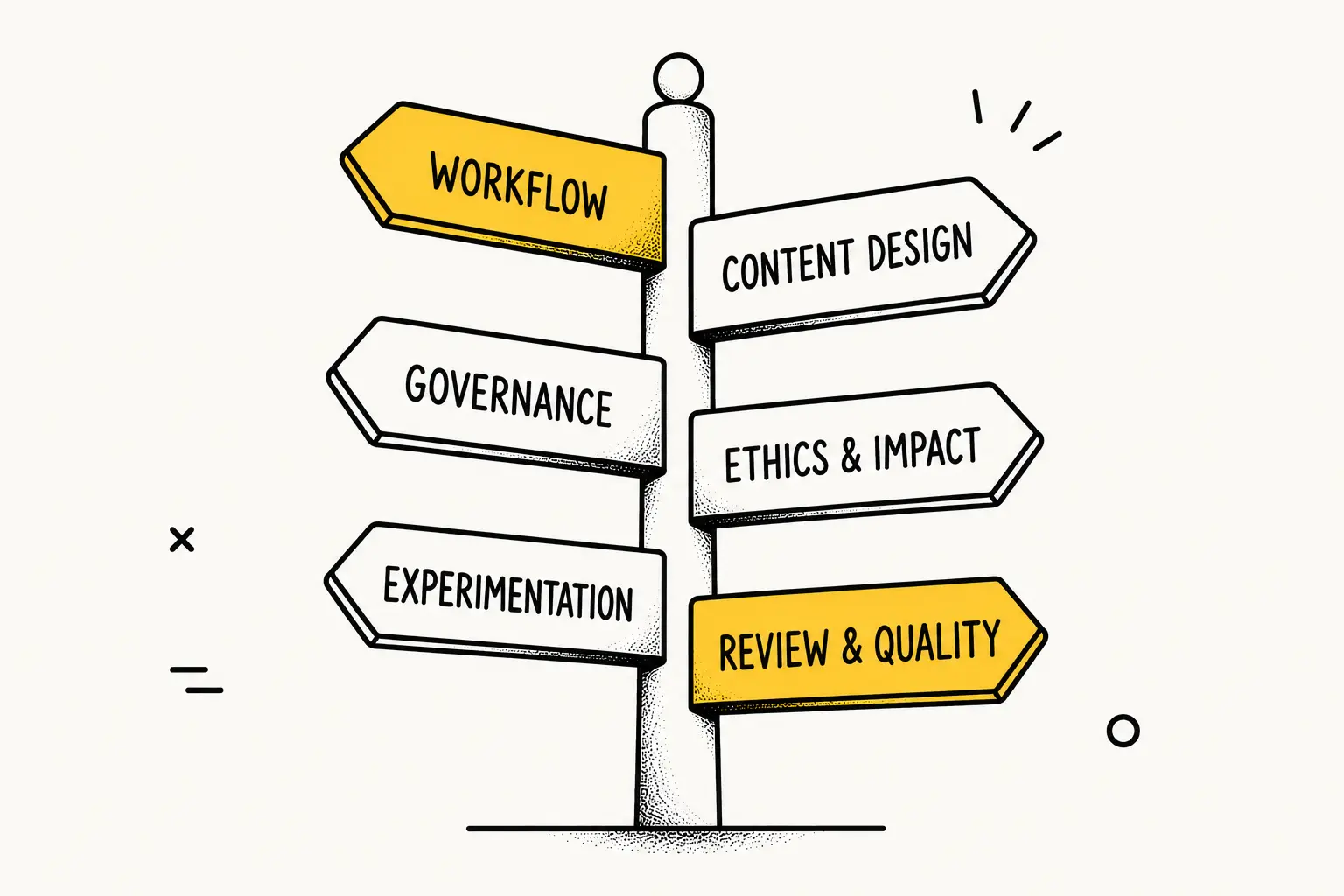
Conversations about AI often jump between tools, ethics, governance, workflows and content itself — not unlike this article. But, we can see how a content strategy provides a framework to answer these big questions and provide appropriate guidance to teams.
Space to play
As we worked through the exercises over the 2 days, the more we began to appreciate the time and space to play. Through our conversations in the weeks since, we’ve started to see play as an essential step to designing appropriate guardrails and grappling with some of those big questions.
When trying to work out how and where AI impacts, changes, enhances, or adds to work and workflows (and to draw your own conclusions about ethics and usage) you need space to try things out. We’re all managing the pace of change alongside our everyday work, and need a little time to explore with curiosity and address our concerns, in a low-risk environment.
This time and space helps individuals see the benefits, issues and limitations for themselves, and ask the big questions without the pressure of a deadline, or risk inherent in ‘playing’ in day-to-day work.
For us, an exercise about image generation in the course led us to bigger discussions of representation and data sovereignty. A conversation about disclosing the use of AI as part of content review processes, led to bigger questions of whether we’re at risk of holding content generated by AI to higher standards of review than that generated by humans.
‘Playing’ in this low-stakes environment has raised big questions that will will help us firm up our own guardrails and internal processes over time, using these to support our internal goals and the client teams we work with.
Beyond the hype
Spend 5 minutes on LinkedIn and you could easily feel behind (and overwhelmed by) the AI curve. For me, the 2 days were a reminder that:
- regardless of what the world of technology, content and design may look like in 5 years, the teams we work with day-to-day need practical support with what’s here now (and an effective content strategy goes a long way to support that)
- AI is a very intelligent prediction engine, but it can’t reason like we can; like any tool, use it for the thing it’s best at, nothing more
- the answers (probably) aren’t in a LinkedIn post, they’re in deep conversation with your peers.
Attending something like this together was a rare treat for Miranda, Mel and me. As a practice area, we work across the studio on projects, rarely alongside each other. It’s been a reminder of the value of stepping out of the work (if just for a few hours) to learn, be challenged, and yes, play, as a team.
Thank you, Content Design London and Weave, and all the course attendees, for being the catalyst for such interesting and deep conversation amongst our team.